Located in Red Hook, NY, Rose Hill Farm is a historic family-owned pick-your-own fruit orchard established in 1798. We grow cherries, blueberries, plums, apricots, peaches and apples on ~114 acres of picturesque farmland. We embrace ecological growing practices that prioritize plant and soil health.
Whether it’s your first time visiting Rose Hill or your hundredth, we look forward to sharing our beautiful and peaceful slice of the Hudson Valley with you!
Hours
taproom
3-8 Thursday, September 17
Closed* Friday, September 18
12-3:30* Saturday, September 19
12-6 Sunday, September 20
Farm stand / PYO
3-7 Friday, September 18*
9-5 Saturday, September 19*
9-5 Sunday, September 20
*Please note that while the farm stand and pick-your-own will be open this Friday and Saturday, the taproom will be closed on Friday for a private event and on Saturday, we’ll be closing the taproom early (at 3:30 pm) for a private event.
*Please refer to Events Calendar or Google listings (Farm / Cidery) for private event closures or special holiday openings which may occasionally affect these hours.
What’s Pickin’?
We will have FIVE varieties of apples available for pick-your-own this week.
Early Fuji: New this week—and this variety will not last the entire weekend! This sport of the original Fuji, which ripens later in the Fall, was found on a limb with the mutation in a Fuji orchard in Washington and patented in 2000. Creamy-colored firm flesh and very sweet. Similar in flavor but ripens about 5 or 6 weeks before the original Fuji. (This variety is located in the Center Hill Block, and the two rows are located due West of the four rows of Honeycrisp.)
Cortland: New this week! A cross between Ben Davis and McIntosh, released to the public in 1915, and was the first apple released by the NYS Agricultural Experiment Station. Named for Cortland County, NY. Large, dark red skin, and soft creamy-textured white fleshed apple. Complex sweet/tart flavor. Good for fresh eating, best in sauces, pies, and salads. (These trees are located in the Pines Block, the row directly to the East of the McIntosh, two rows up from the blueberry patch.)
Pioneer McIntosh: This strain of McIntosh is very similar to the original McIntosh which is believed to be a seedling of the once prized Snow/Fameuse variety discovered in Ontario, Canada in 1811. The coloring of about half green/half dark red is very beautiful and the thick skin gives way to a very vinous, tart yet savory flavor. Classic for a good reason! (This variety is found in the Pines Block, just up from the blueberries.)
Gale Gala: This strain of Gala was discovered in a Washington state orchard and then propagated because of its redder than the usual Gala quality. Very sweet, juicy, and crunchy. Excellent for fresh eating, and also good in pies or tarts. (This variety is located in the Pump Pond Block next to where the strawberries used to be. There are 3 rows.)
Jonamac: Introduced in 1944 at the NYS Agricultural Experiment Station. A cross between Jonathan and McIntosh. Acidic and slightly tart now, and in the next couple of weeks as the fruit hangs, they develop some sweetness and more balanced flavor. It turns out, these trees are some of the oldest on the farm here, planted in 1978 and 1979. For this week, look for the darkest fruits as they will be the ripest and have the fullest flavor. This variety is located up the main orchard road, Center Hill Block, on the righthand side of the road. There are four rows, situated between the Empire.
We will have all five of these varieties available pre-picked at the farm stand.
We will also have the following varieties available pre-picked at the farm stand:
Jonathan: A seedling of Esopus Spitzenburg from the farm of Phillip Rick, Woodstock, Ulster County. Described by Judge J. Buel in 1826. This is one of the parents of apples like Jonamac and Jonagold. It is a medium sized apple with green/yellow skin that is overlaid with a beautiful red to dark red blush. The flesh is white to yellowish, firm, very juicy, mild, sweet with some tartness. A very fine apple with a lot of local history embedded in it. For instance, in Woodstock, some old timers call this apple “Rickey” or “The Rickey". Very limited quantities.
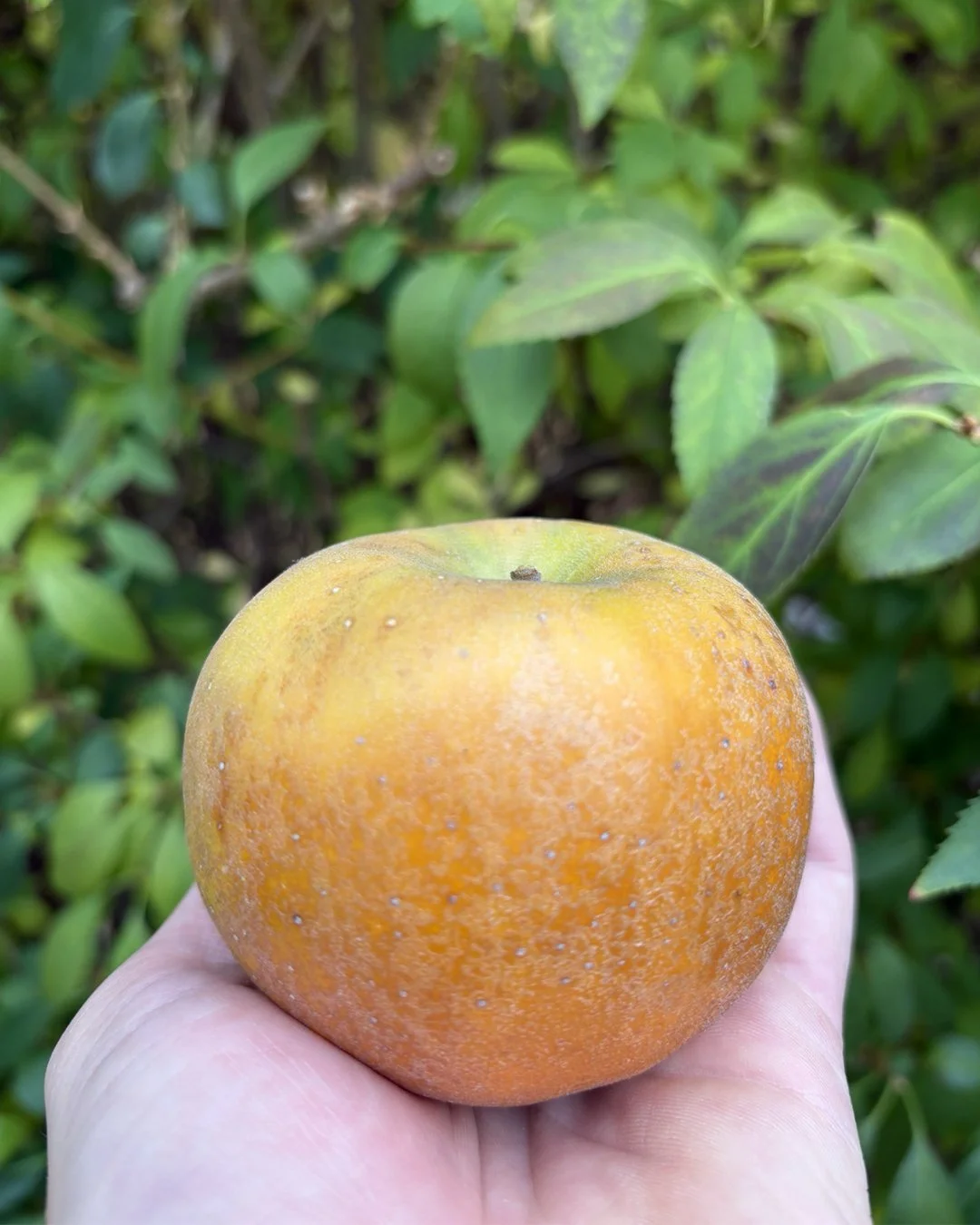
Holstein Cox: While this variety was introduced in 1950, it was discovered in about 1918 Eutin, Holstein, Germany by a Mr. Vahldik. It is believed to be an open-pollinated seedling of Cox Orange Pippin and is quite similar in taste. It is typically a medium-large sized apple with greenish to deep golden-yellow skin with various levels of orange and red blush covering the skin. Occasionally there are bits of russet on the skin. The flesh is yellowish-white, firm, and coarse. A very sprightly subacid flavor that turns sweeter. Complex and aromatic flavor.
Ginger Gold: A seedling apple variety that appeared in the orchard of Clyde and Ginger Harvey in Nelson County, Virginia in 1980. It is a medium to large apple (there are some real whoppers hanging out there now!), round to oblate, with green to yellow colored skin. When the skin turns yellowish, it is ripe, crisp, and juicy with a pleasantly sweet flavor. The cream-colored flesh is slow to oxidize making it great for salads and desserts as it holds its shape when cooked. Very limited quantities.
Kerr: A truly special fruit. This variety was created by crossing Dolgo and Haralson done by W.L. Kerr at the Canada Experimental Farm in Manitoba and was introduced in 1952. Striking garnet red turning to deep purple skin, small, roughly 1-1.5 inches in diameter. A very condensed and robust flavor—sweet, tart, and heavy on the rose flavor. Great for eating if you are into a little more complex and intense flavors. Makes phenomenal jams/jellies. Very limited quantities.
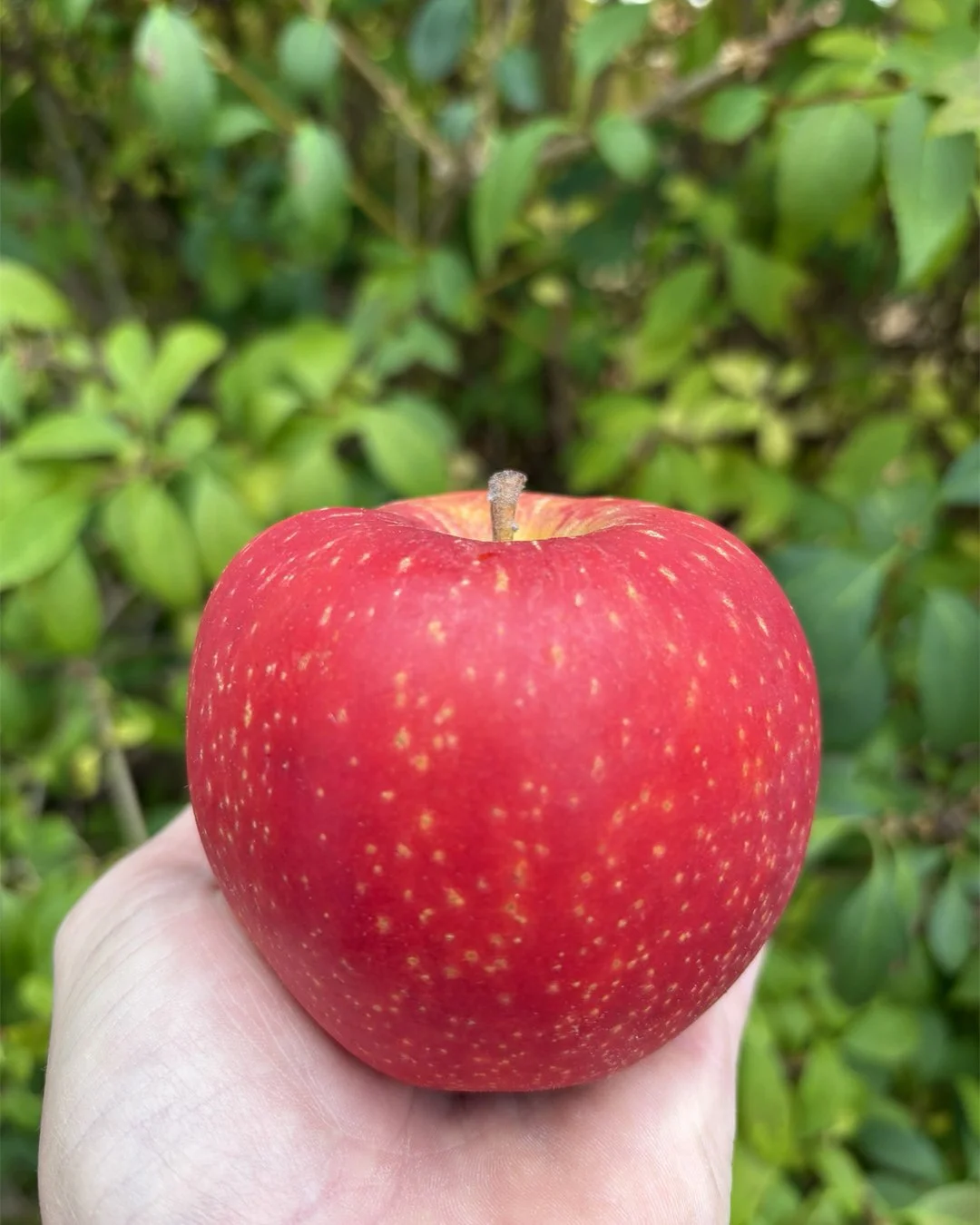
Fulford Gala: The most widely planted variety across the globe. This is a solid blushed strain of Gala that was noticed in New Zealand by W. Fulford in 1983. Most Gala strains are identified by their stripes, while this one has a pretty, bold, and solid blush. This strain in particular is exceptionally beautiful—red with lovely lenticels. A true sweet apple. A friend of mine calls them "monotonal", and for those that love a properly sweet apple, this is a nice and simple pleasure. Great for fresh eating and dessert making.
Honeycrisp: The legend itself is back! The highly sought-after Honeycrisp was released in 1991 by the University of Minnesota. Most people rave and rave about this apple. Some despise it. Let them do whatever they are going to do. This is a beautiful apple with mostly red streaking over a greenish background. The patterns and designs on the skin are quite incredible. It is pretty singular in its sweet crunchiness—a one trick pony, so to speak. The texture is rather rare in that the cells of the flesh are large and break away very cleanly, allowing the sweet juice to almost explode in one's mouth.
Join us in the taproom Thursday through Sunday for locally-crafted drinks and food pop-ups. Keep an eye on our events calendar for upcoming live music, featured ferments (tastings by other NYS makers), classes, festivals, ticketed dinners, and more. See you soon!
Browse our Food Vendor and Events Calendar.
See Rajiv Surendra’s recent visit to the farm for HGTV Handmade!
Follow Our Adventures:
Find Out More:
Address: 14 Rose Hill Farm, Red Hook, NY 12571
Conveniently accessible from I-87 and the TSP yet peacefully tucked away off the beaten track.
Directions from NYC: Take Taconic State Parkway N to exit 67 (toward Pine Plains/Red Hook). Turn left at NY-199 W. Enter Village of Red Hook, NY-199 becomes Market St. Turn right onto Route 9. Turn right at Fraleigh Lane. Make left into Rose Hill Farm.